Ella, Riley, and Victoria's Stories: Life Can Change in the Blink of an Eye
Public service and advocacy run deep in the LaVigne family.

Olmstead v. L.C. was a critical case for disability rights. The administration wants to disregard it.

by Jenny McLelland
Two years ago, my son James was invited to speak at the Department of Justice in Washington D.C. at an event celebrating the 25th Anniversary of Olmstead v. L.C.
Olmstead is a 1999 Supreme Court case that said disabled people have a right to receive care in their own homes and live in the community, rather than being forced to live in segregated institutions.
Our family got to meet with disability rights advocates and civil rights attorneys to talk about how Olmstead makes it possible for kids like James to life happy, healthy lives at home with their families. We also talked about the challenges we faced in bringing James home from the hospital – he spent most of the first year of his life in a nursing home because the system that was supposed to help us care for him at home simply didn’t work
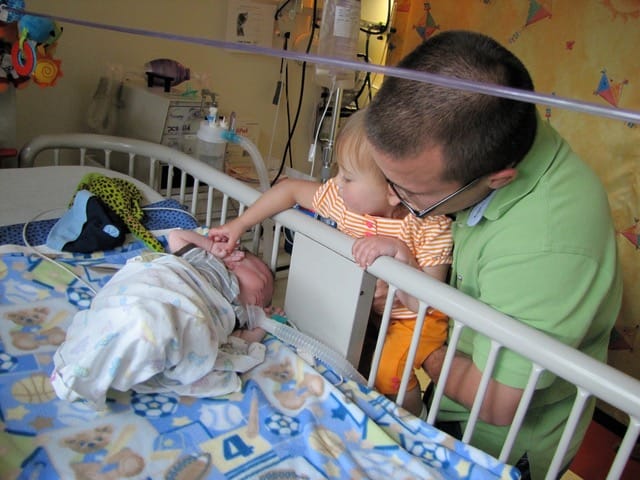
On June 18, the Department of Justice issued a convoluted legal memo saying that Olmstead doesn’t really mean that disabled people should be able to live anywhere other than an institution, and even if it did, that the federal government doesn’t really have the authority to tell the states to follow civil rights laws.
As a mother of a disabled child, I’m terrified of what this means for kids like my son – and I’m ready to fight back.
Today, my son James is an Olmstead success story, but that wasn’t always the case.
James has a rare genetic syndrome that affects cartilage growth. The gene that was supposed to tell his body how to build an airway decided to slack off, making his natural airway too small and floppy to breathe through.
Doctors gave James a tracheostomy (a surgically placed hole in his neck, held open by a plastic tube) right after he was born so that he could breathe.
The doctors at the hospital where James was born didn’t give us the option to bring him home. They said if we brought him home, he would die and it would be our fault. They said that even if he lived, his needs would be so overwhelming that our family would fall apart.
Instead of coming home to live in the nursery that we had prepared for him, James went to live in a pediatric nursing home 200 miles away from our family.

For a baby with a tracheostomy, the biggest medical concern is keeping the airway open. The tiny plastic tube can become clogged with secretions, a problem that gets worse every time the baby cries.
But a baby crying isn’t a medical problem-–it’s just a thing that babies do. You don’t solve the problem of a baby crying by suctioning a tube. You solve the problem by picking the baby up.
In the facility, there was never enough staff to pick the crying babies up.
If we weren’t at the facility, James would cry alone in his crib for hours. He would cry so long that he vomited, and he would lay in the vomit for long enough to burn his skin. The facility worried that he wasn’t gaining weight fast enough, so doctors moved his feeding tube to bypass his stomach completely and deliver formula directly to his small intestine so that he wouldn’t have any food in his stomach to throw up.
They want disabled people to be somewhere else, where they don’t have to think about them or look at them.
That’s the kind of solution that institutional care provides.
On paper, institutional care provided 24/7 nursing.
In reality, institutional care met his medical care needs-–but it neglected his most basic human needs.
At the time that this happened to our family, I didn’t have the vocabulary to know that my son was institutionalized. I didn’t know what that word meant. I thought that “institutions” meant some big scary brick building from black and white pictures of the past.
The place where my son lived was clean and nice. It had a play room with toys and a swingset in the back. It had bright colored murals and on the walls. The staff loved the kids – but it was still a job and they clocked out after every shift. They weren’t family. It wasn’t a home.
Institutionalization for children today isn’t a thing of the past. It happens in specialized pediatric nursing homes like the one where James lived. In some states, children are placed in adult nursing homes without any pretense of providing a kid friendly placement. Kids who are especially medically fragile can end up living in acute care hospital ICUs for years at a time.
We were told that James had to live in the nursing home because the risk of him dying because of breathing problems at home was too great. As the months went by in the nursing home, we learned that kids still died there.
We eventually figured out how to get James home. There was paperwork… so much paperwork. He qualified for nursing care at home, but the rate that Medicaid would pay for that care was so low that it was nearly impossible to actually find a nurse. Even when the federal government believed in Olmstead, access to care at home was still a work in progress.

Today James is 15. He’s about to start his sophomore year of high school. As I write this, he’s sitting next to me at the kitchen table working on his summer English reading assignment (Fahrenheit 451, which I’m glad to know is still in the curriculum).
Medicaid pays for a nurse who comes to our house every night to manage James’ breathing machines. We can go to sleep and be confident that our child will still be alive in the morning when we wake up.
James attends school with a nurse who manages his breathing so that he can focus on learning. He negotiates with his nurse to stay after class if he needs to re-take a math test or stay late to audition for the school play.
The administration’s Department of Justice is trying to make a very simple moral question seem complicated by rambling on about interstate commerce, federalism, and (weirdly enough) online sports gambling for 40 pages. They’re using complicated legal language to obscure an ugly truth – they don’t want to see disabled people. They want disabled people to be somewhere else, where they don’t have to think about them or look at them.
The point isn’t just to send kids to institutions, it’s to scare families out of asking for services at home with the threat of losing their children.
The first order of business is to not be intimidated by 40 pages of legal mumbo-jumbo. They’re hiding behind legal language because putting disabled kids in institutions is incredibly unpopular. And this memo is an opinion: It can’t casually overturn decades of legal precedent. Families and disability organizations are ready to take this to court to protect their rights, and their children’s rights.
Talk to your legislators and ask them how they plan to protect disabled kids right to get care at home.
Contact Little Lobbyists to learn more about how you can join us, tell your story, and find power in community.
Tell friends, family, and community members about your child and other medically complex and disabled children, and tell them that the administration wants to send them to institutions, rather than supporting them in their communities. Ask them how they feel about, and tell them how they can help.
We know it takes a village to take care of a child: It takes a village to protect children, too.

Public service and advocacy run deep in the LaVigne family.

Violette is an opinionated girl who marches to the beat of her own drum. Thanks to Medicaid, she does that at home, not in an institution.

Advocacy, within my capacity, is so important to me. Telling my family’s story helps people understand the importance of an equitable and just care system.

JW is a kind, resilient, caring child who counts on Medicaid for his lifesaving seizure medication.