Ella, Riley, and Victoria's Stories: Life Can Change in the Blink of an Eye
Public service and advocacy run deep in the LaVigne family.

Public service and advocacy run deep in the LaVigne family.

By Shannon LaVigne
My name is Shannon LaVigne. I’ve lived in Albany with my husband Kevin for 24 years. We have three children, Ella, Riley, and Victoria, along with our two dogs, Cody and Cooper.
Ella is 14 and she is bright, quirky kid who’s very strong-minded and determined. The fact that she once dressed up as Ruth Bader Ginsburg for Halloween tells you a lot about her! Since she was about three, she’s wanted to go to med school. Other kids would watch videos about toys, and she was watching heart transplants with an anatomy and physiology textbook on her nightstand. She’s also an advocate in her own right even though she doesn’t like to think so. She’s won the President’s Education Award and participates in the school equity committee.
Riley graduated last year. He’s a huge Star Wars and Transformers nut, and loves our dogs: Cody was actually supposed to be a service dog we were going to train, but now he’s just a certified best friend. Riley often goes to the capital with me, where I’m known as Riley’s mom, which I love. I will put it on a nametag one day!
Victoria is 29 and just recently had her first child, Oliver. Like my other two, she’s also very much an advocate—you could say public service runs in our family. She’s starting to learn to advocate for services for her own son as she adjusts to being a new mom. She started the Best Buddies club at the high school and won an award and she has also worked as a direct support worker.

I left the corporate world when Riley was born because our life had grown so fast-paced and hectic. I wanted to stay home with my children and be consistent and supportive with their care. I ran a daycare out of the house for almost 13 years so I could stay home.
But then life started to change for us. Riley got sick and we started on the path of diagnosing him with mitochondrial disease. He went from playing baseball, soccer, basketball, and lacrosse to coming home and napping every day, sometimes for six hours or more. Then he started becoming nonresponsive at school and they sent him to the ER several times.
We went to a physical medicine doctor and they initially worked Riley up for muscular dystrophy, and finally another doctor looked at his labs and said “I think he has mitochondrial disease.” I had never even heard of it. There weren’t a lot of testing options—he told us to take supplements and see how Riley did, and he started to improve, until he got strep throat and it became very apparent that he’d need more than supplements.
Right as Riley started getting sick, so did Victoria. She went from running track and being very active to struggling to get out of bed. At first, they attributed this to her autism and mental health, but we kept pushing, and she got what felt like every test on the planet.
Then Ella needed brain surgery in the first grade because of an issue with her KRIT1-gene that causes cavernous formations to develop in her brain. I had to be in Boston a lot for her care, and our other children were also in and out of the hospital, sometimes for months at a time.
I needed to close my daycare to focus on my children's care.
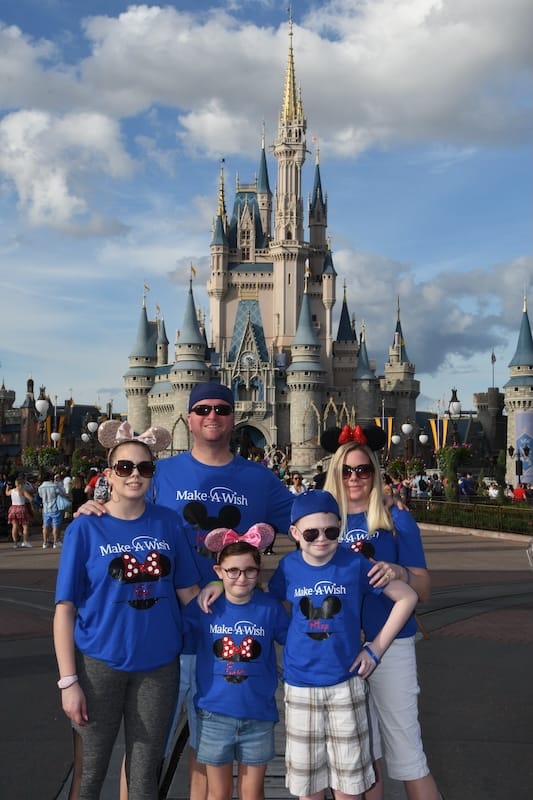
All three of my children have mitochondrial disease in different forms of severity in addition to other medical conditions, like Victoria’s autism and Ella’s KRIT1 mutation. None of them presented at birth, and they all had medical mysteries that required many doctor’s visits, tests, and challenges to correctly diagnose.
With Riley, we got a diagnosis within two years for something that can take seven to ten to diagnose, which was incredible. We really landed with the right doctor at the right moment.
In our household we call mito “the great thief,” the one that comes in the night and doesn’t ask questions. It just takes.
Riley is the most severely affected. Every day can be a struggle to get moving. He currently needs TPN for his nutrition and takes a lot of IV medications and infusions. His muscle weakness affects his lungs, so he needs to do a respiratory routine twice a day. He’s also developing kyphosis, where his back is curved over and his ribs are turning. We have to work really hard to keep any kind of illness out of the house. Much to his delight, he’s on hormone replacement therapy to help him catch up on his growth, so he’s finally getting a chance to go through puberty, at almost 20 years old.
Our health care needs are well beyond the scope of my husband’s insurance, even though it’s amazing. He works for the state and we receive the same coverage members of the Assembly and Senate give themselves. It does not pay for a minute of my son’s nursing, and for so many other things that he needs, like a pharmaceutical-grade supplement that’s essential to his wellbeing. At one point I was mix and matching formulations because we couldn’t afford it. In one year, we had 16 hospitalizations across all three of our children and bills were piling up, even with my husband working multiple jobs to support us.
When I was talking about this with my friend Linda, she asked whether I had a Medicaid waiver. I’d never even heard of that, I had no idea Riley would qualify for Medicaid. No one ever told me “hey, you can get this for your son, they can cover leg braces, his wheelchair, home modifications…” This help is available to everyone who qualifies: It’s not a handout and the path to applying and keeping him on the program is not easy. But it’s the reason Riley can live at home with his dogs and his siblings, and every child who needs it should have that support.
After how much I struggled with getting Riley the diagnosis and services he needed, he became my drive. I decided to go back to school, got a certificate in public policy, and started as an education advocate, using my sales background, which applies really well to public policy. I took over a nonprofit that someone else started, Mito Help and Home, for people with mitochondrial disease and their families, and started volunteering with the New York Alliance for Developmental Disabilities. It only grew from there. During the early days of COVID, I connected with fellow New Yorker Linda Molina and we founded, along with Assemblywoman Missy Miller, Voices for the Medically Fragile of New York.
One thing we’re thinking about in New York right now is what to do when families can’t get nursing: They might have the hours, but they can’t locate a provider. For example, we are eligible for 120 hours of registered nursing care at home, but it took us three years to interview our first provider. We need a registered nurse, not an aide or licensed practical nurse, to handle Riley’s TPN and other complex needs. I can only fill about 40 hours now and it’s only because of a small miracle: My best friend started out as a registered nurse and now she’s a nurse practitioner who needed a lighter, more flexible job. But we know the pay is low and she’s overqualified, and she’ll have to leave.
It’s so hard. I feel for the nurses. The pay is low and they don’t get paid leave and benefits. If my son goes into the hospital they’re without work, if he’s out of the house on appointments, they don’t get paid. They’re doing this work because they love it and they love their families. We have parents dropping out of the workforce to provide this skilled care, or staying in bad situations like domestic violence because it’s too dangerous to leave. We’re working on the Complex Care Assistant Act, which just passed in the Senate and would allow family caregivers to be paid for their work through a nursing agency after undergoing training.
We’re running mini-ICUs in our homes. Nobody knows anything about us and they’re shocked when we tell them and welcome them into our lives. I talk about this and people will ask “why should we pay a parent to stay with a kid?” This is not a bowl of chicken soup. These are lifesaving things that require years of education and experience and we’re performing them after a five-minute lesson during a hospital discharge. I want lawmakers and policymakers to come visit us in our homes and see what it’s like.
I tell people that your life can change in the blink of an eye. No one plans for this. You’re planning for going to college, getting married, buying a house, having children, but you’re not thinking you’ll have $250,000 a year in health care expenses for your child. When you’re registering for a baby shower, you're not thinking about wheelchairs, hospital beds, IV pumps, feeding pumps, oxygen tanks, oxygen concentrators, pulse oximeters, nebulizers, cough assist machines, or the hundreds of other medical supplies it takes to keep our loved ones at home.
That’s why this work is so important to me: I show up for kids like Riley and parents like me every day, to make sure people understand the programs we count on and our children’s right to live in the community.

Violette is an opinionated girl who marches to the beat of her own drum. Thanks to Medicaid, she does that at home, not in an institution.

Advocacy, within my capacity, is so important to me. Telling my family’s story helps people understand the importance of an equitable and just care system.

JW is a kind, resilient, caring child who counts on Medicaid for his lifesaving seizure medication.

Little Lobbyists' intern Grace Heuer writes about taking the fight to Capitol Hill...and rethinking what advocacy can look like.