Peter's Story: A Dog-Loving Prankster Counting on Home Care
Mississippi Medicaid is what allows Peter, his brother Zachary, and his widowed mother Lisa to live happy, healthy lives.

Attorney and Little Lobbyists powerhouse Charlotte Cravins talks about the power of speaking before the legislature.

By Charlotte Cravins
For the first time ever, I testified at the Louisiana State Capitol this session, which might be surprising if you know me, since I’ve worked in and around the legislature for years. I had never once sat at those tables myself, and as a former House staff attorney, I was more nervous than I’ve ever been to speak in public. I just kept reminding myself of the first step: introduce yourself for the record.
I’m Charlotte Cravins. Louisiana-licensed attorney. Co-lead of Little Lobbyists Louisiana.
Then I said I was Landry’s mom.
He was with me to testify for HB 1, our state’s budget bill. He tried to testify by touching everything, so I did have to pass him to Jordan Camp, our Louisiana state co-lead. We were there to ask the House Appropriations Committee to fund increased Home and Community Based Services (HCBS) rates and Direct Support Worker (DSW) pay. DSWs are the people who come into our homes and do the hands-on work that keeps our children safe.
In Louisiana, it’s nearly impossible to get respite care before your child turns three, so I told them what the first two years have looked like in our house without it.
I told them about Landry’s oxygen needs when he came home, about his feeding tube, therapy schedules, the medical equipment, the prior authorizations and renewals, the evaluations, and how we’re trying to learn all of this while learning how to be new parents too. I told them what it felt like to try to physically, mentally, and emotionally recover from a high risk pregnancy and a lengthy NICU stay while also learning how to keep a medically complex child stable at home.
I told them the lack of help was not because families like ours do not need it. The biggest contributor to my postpartum depression was lack of sleep. I have not been to a doctor since my six-week postpartum checkup two years ago. I said all of it into the microphone, on the record.
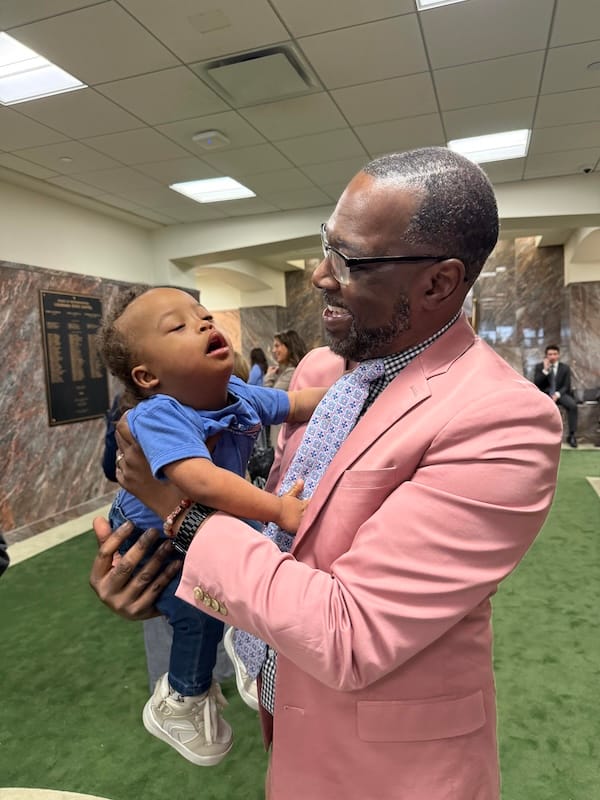
Several legislators came out after our HB 1 testimony for photos with Landry and to thank us for testifying.
On the walk back to my car, pushing Landry in his teal umbrella stroller, people kept stopping us to say how powerful our vulnerability was that day.
I came back to testify on HB 342 on a different day, so Landry wasn’t there. He had therapy, which I said in my testimony, because even being able to show up to testify isn’t easy in our situations.
This time I was less nervous. I had done this once, and I could do it again.
This bill was about who has to prove a placement is appropriate when a parent thinks a school got it wrong. Right now, in Louisiana, the parent has to prove their child’s placement isn’t appropriate since they’re the ones challenging the placement. Shifting the burden to the school district, like this bill does, evens the playing field in a scenario where parents are up against a school district with staff attorneys, contracted law firms, evaluators on staff, and institutional knowledge most families will never have access to.
Landry is about to age out of Early Steps and enter the school system, so we have been trying to understand the rules before we’re entrenched in them. What we keep hearing is not that the process gets easier, but it does get more formal and more expensive to fight for your child’s education.
I sat and explained to the House Education Committee that the evaluations our school districts rely on are not built for kids who cannot tell you verbally what they know, yet Landry understands far more than he can express. If he is evaluated with standard tools and placed somewhere that does not challenge him, that result will reflect the limits of the test, not the limits of my child. I explained that under current law, the district would not have to prove that their placement was appropriate, instead us parents would have to prove that it was inappropriate for Landry’s abilities and educational needs. HB 342 shifts that burden to the party proposing the placement.
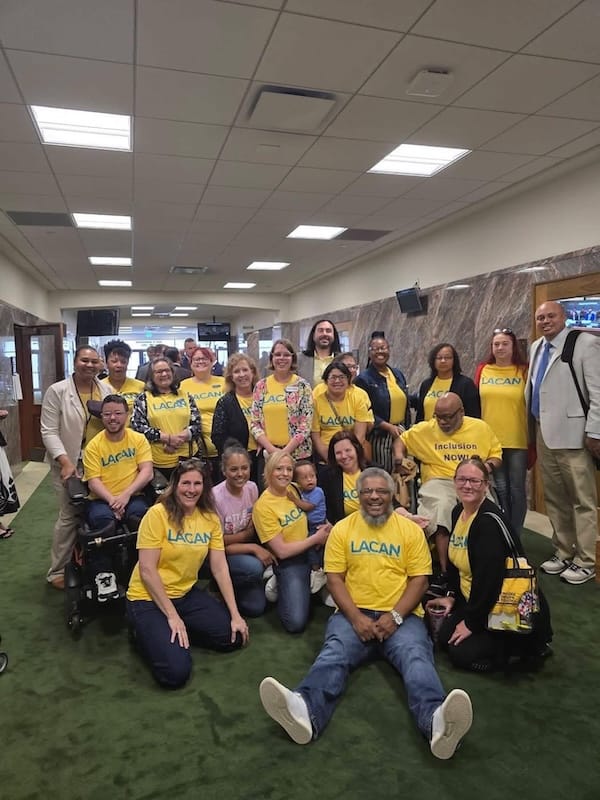
It passed the House Education Committee unanimously. After we finished, Representative Knox, the bill’s author, gathered those of us who had testified in support for a photograph, and then we stood in the halls of the Capitol for a while and discussed next steps.
HB 342 passed the full House 99 to 2 and is now waiting to be scheduled in Senate Education.
The HCBS funding I testified for in HB 1 was not included when the budget left the House. LDH had previously commissioned a rate study which found it would take $53.6 million in state general funds to increase HCBS rates and DSW pay, and told the House Appropriations Committee they needed more information. They don’t plan to address DSW pay or HCBS rates until next year. We don’t know yet how either bill will look after moving through the Senate.
I know how it felt to sit at those committee tables and tell our story out loud on the record. A state representative I’ve known since we were both kids looked at me from the dais after my HB 342 testimony and said that Landry’s story is making an impact at the Capitol. I believed him.
Families of children with disabilities don’t go to the Capitol because it’s easy or because we love the drive or because we have so much time to spare. We go because we’ve calculated, correctly, that our children’s lives are worth the trips. We go because someone has to tell our kids’ stories out loud, and it might as well be us, since we already know all the words.
If you’re a Little Lobbyists family who has thought about testifying and talked yourself out of it, you already have your testimony. You live it every single day. The only difference between you and the people testifying is that they’ve already gone and said their story out loud.
Charlotte Cravins is a Louisiana-licensed attorney and state co-lead of Little Lobbyists Louisiana.

Mississippi Medicaid is what allows Peter, his brother Zachary, and his widowed mother Lisa to live happy, healthy lives.

Olmstead v. L.C. was a critical case for disability rights. The administration wants to disregard it.

It's already hard to meet basic needs. Without Medicaid, it would be impossible.

Born with a Vein of Galen aneurysm, this opinionated eight-year-old gets the support he needs to thrive through Medicaid.