Ella, Riley, and Victoria's Stories: Life Can Change in the Blink of an Eye
Public service and advocacy run deep in the LaVigne family.

Born with a Vein of Galen aneurysm, this opinionated eight-year-old gets the support he needs to thrive through Medicaid.

By Courtney Carlson
My name is Courtney Carlson. I live in Illinois, in the suburbs of Chicago, with my husband Josh and eight-year-old son Theo. I learned about Little Lobbyists through my friend Nancy, who joined Little Lobbyists in Washington, DC, last summer when hit the halls of Capitol Hill to advocate for Medicaid.
Theo is an incredibly sweet, but also stubborn, kid. He loves his music, especially Disney music, and anything bright and shiny that makes a lot of noise. Unsurprisingly all of his toys make a lot of noise! He’s obsessed with them: He says his toys are his best friends. He’s also a big personality who’s unafraid to share his opinions. He’ll have story hour at school and the teacher will say “what did you think?” and he’ll say “that was boring.” Someone will ask “Theo, do you like my pants,” and he’s like “those are gross.”
Theo was born with a Vein of Galen aneurysm, a very rare blood vessel malformation that happens in around one in 25,000 births. It was diagnosed when I was 32 weeks pregnant. At the time, it was really scary: We have such great doctors here, though, and they took really good care of us. We lucked out: When we were referred to a children’s hospital, one of the doctors there happened to be familiar with the Vein of Galen aneurysm and was uniquely qualified to do the surgeries Theo needed.
At six months old, he had his first brain surgery to block the affected blood vessels with 98 feet of hair-thin platinum coil. After his third brain surgery Theo developed hydrocephalus, which caused brain damage and complications including cerebral palsy and Lennox–Gastaut epilepsy. Due to PTSD from his complicated hospital stay, Theo stopped eating orally and ended up with a g-tube a few months later. Since then, he’s had nine more surgeries including a craniotomy, shunt, double hip surgery, and a VNS (a device used to help control seizures).
I think Theo’s stubborn personality is what’s kept him alive for so long. Astonishingly, his medical imaging shows that his brain is trying to heal, so it’s hard to tell what might happen for Theo next. Right now, he uses a wheelchair full-time and he’s non-speaking, he uses a device for communication. He’s very expressive. He laughs, interacts with people, wants to touch people and say hi.
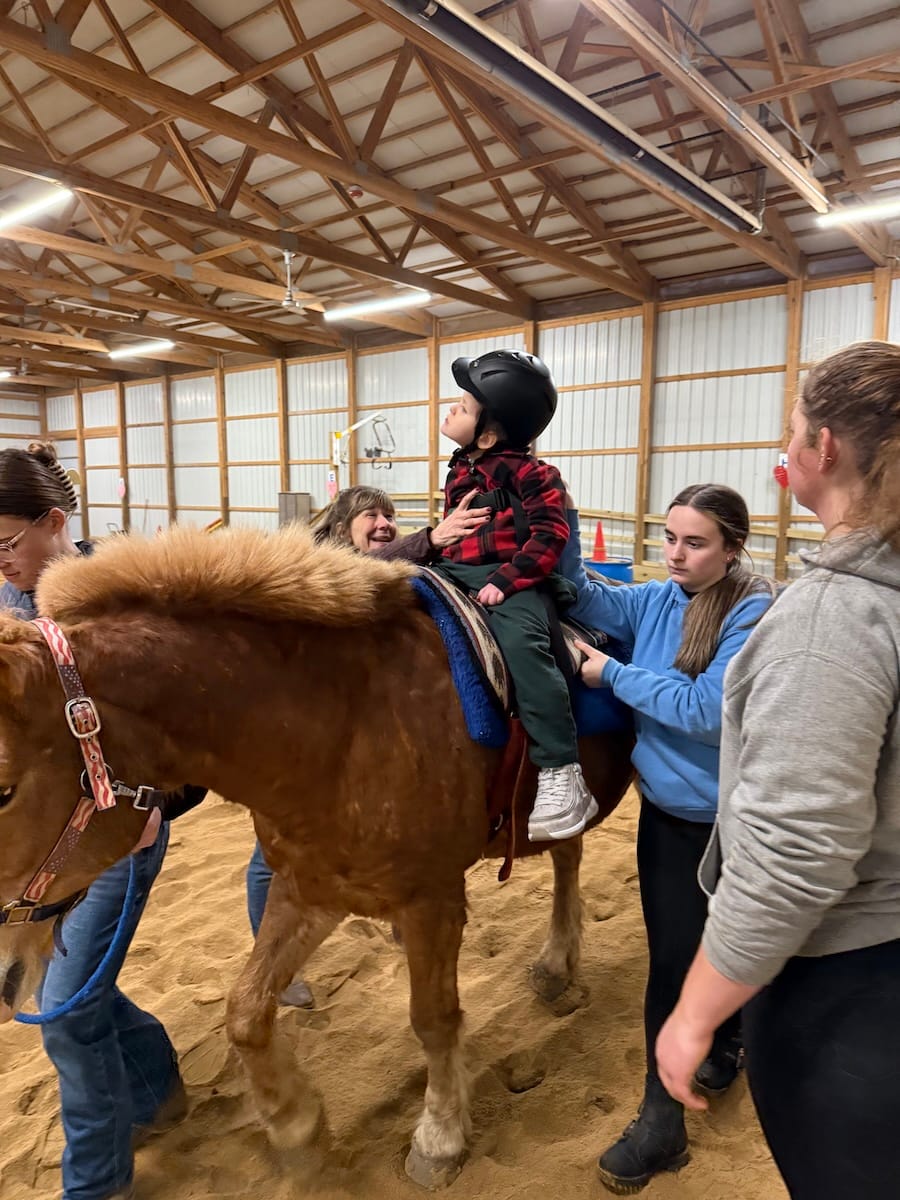
At 5:30am, he’s up and ready to play. He takes his medications and gets ready for school; his nurse comes over around 7am and joins him on the bus. That nursing care is essential for Theo’s safety and ability to go to school and live here in the community. At school, he’s in a class with other kids who are multi-needs, and they have so much fun. He loves his classmates. Theo gets home around two and then it’s usually off to a medical appointment, occupational therapy, equine therapy—he loves Sherman the horse!—or other necessary care. By seven, he’s asking to go to bed.
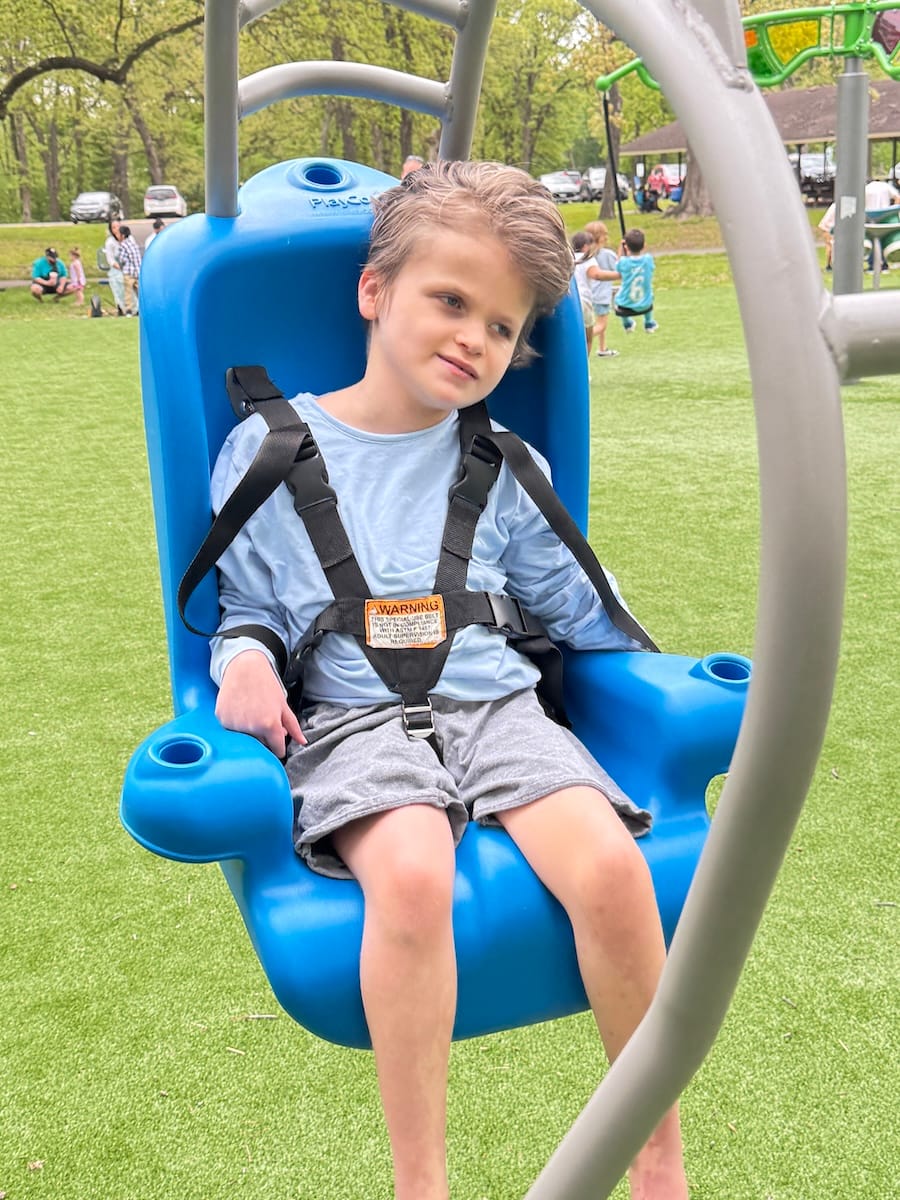
Theo needs a lot of technology to thrive. Overnight, he does a slow feed with a pump to make sure he gets the nutrition he needs. He cannot eat by mouth and he’s allergic to dairy and soy, so he needs a very specific formula. Theo also uses a shake vest to clear his lungs. He’s needed a stander, a bath chair, suction, a cough-assist device…thousands of dollars’ worth of medical equipment that his insurance just refused to cover.
We were going to other states to buy used equipment from other families! It wasn’t just medical equipment: We were struggling financially to pay for a lifeflight, hospital services insurance wouldn’t pay for, just so many things. Finally, we were able to access the MFTD, a Medicaid waiver for medically fragile children who are dependent on technology. There’s a points system: For a while, they decided Theo was sick, but not sick enough.
It’s been fun to find this side of myself, to go out and fight for these things that are so important for a lot of people and raise awareness.
Before Theo, I wasn’t really aware of how hard it was to get support for medically complex children, and I didn’t understand the issues kids like Theo faced. I had a standing reservation with the Red Cross to donate blood, but I hadn’t interacted much with the medical system beyond that. Theo’s birth introduced me to all these issues and made me an advocate.
One part of my work that I’m really proud of is my work with Changing Spaces, an organization that advocates for adult changing tables in public restrooms. Their work is essential: It’s not just infants who need changing tables. With Theo, I need more room to change him to accommodate all his equipment, for example. We just got a bill through the Illinois house and it’s currently going through the senate.
I still remember going to testify in front of the Senate’s Executive Committee—I cried during my testimony and it actually went a little viral! Working to organize people has had such an impact: When Republican lawmakers came out against the bill, I was like “I don’t care, we’re gonna make this nonpartisan, we’re gonna flip this, people.”
I was shocked when I talked with my Republican representative and thought “there’s no way he’s going to go for it,” but it worked. He went with his constituents, not his caucus. Ultimately, we got five Republicans to flip, and one even became a cosponsor. Seeing that effect on the state level is so energizing, this kind of success shows me that change is much more doable on the state level.
It’s been fun to find this side of myself, to go out and fight for these things that are so important for a lot of people and raise awareness. I was kind of thrown into it, but I’m definitely a more type A, outgoing person. I know some people can feel shy, and I’m like “come with me! Let’s do a rally!” Once people take that first step and see that it’s not just going to impact them, it’s going to impact so many other people, they see how important it is, and the difference they can make.

Public service and advocacy run deep in the LaVigne family.

Violette is an opinionated girl who marches to the beat of her own drum. Thanks to Medicaid, she does that at home, not in an institution.

Advocacy, within my capacity, is so important to me. Telling my family’s story helps people understand the importance of an equitable and just care system.

JW is a kind, resilient, caring child who counts on Medicaid for his lifesaving seizure medication.