
Stacy's Story: Tapping In to a Sense of Empathy
Long-time Little Lobbyists mom Stacy Staggs talks about sharing her story, with tips for those who are new to advocacy.
By Stacy Staggs
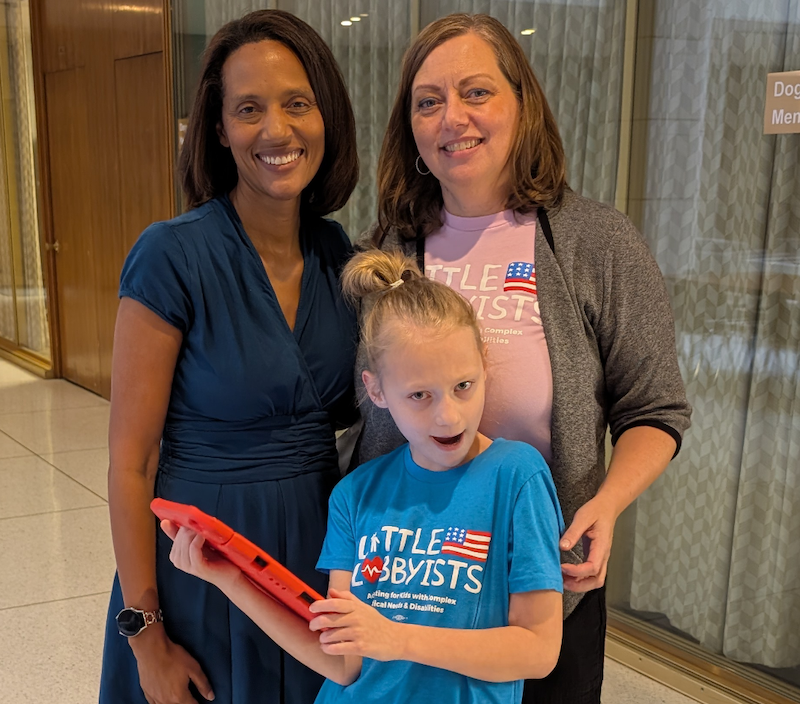
A couple of weeks ago, I drove to Raleigh with my 12-year-old daughter Sara because both chambers of the North Carolina legislature were back in session and had not yet passed a budget. It’s not the first time I’ve traveled to meet with legislators, and it wouldn’t be the last. For people who are new to Little Lobbyists and advocacy, I thought I would share our story so you know what it’s like. Having done this before and having traveled to Capitol Hill too, I’m comfortable talking to state legislators. I have the background, I know where the twists and turns have been. I follow closely because it affects my family directly.
I brought printouts of Sara’s sister Emma’s story that I could hand to legislators and I also had a list of the people I wanted to be sure to connect with, for example a couple of people on the Joint Legislative Oversight Committee on Medicaid. I don’t need a lot of time with my representatives because they already know me, I don’t have to convince them to protect Medicaid. I was really trying to focus on lawmakers who are less tuned in and get some answers, share my story, and tap into a sense of empathy.
I have removed any mystique from elected legislators that I might have used to feel. I know they are regular people.
Heading up there, I had a phone conversation with a statewide reporter, Michael, with Cardinal and Pine, they had been fantastic connecting with Little Lobbyists families since the summer. He would be at the Capital as well and wanted to get some words on camera to share on their social media, so when we got there, I met him at the entrance of one of the legislative buildings. I happened to be behind a large group of protesters who were there to protest the lack of a budget. A lot of them were teachers, but they came from all walks of life. There were other news cameras and coverage, Democratic lawmakers, it was a bustling day at the legislature!
I was able to connect with a senator who is a prominent member on the committee. I captured him in the stairwell because I recognized him. They had just ended a discussion without even allowing Medicaid to come to the floor. I have removed any mystique from elected legislators that I might have used to feel. I know they are regular people and they are particularly vulnerable to what donors want. I’m in there as a non-moneyed constituent whose children are end users of these programs and directly at risk from cuts. I feel compelled to talk and that gives me a bravery that I might not feel otherwise, for example chasing down a senator in a stairwell!
I asked him why they kept Medicaid off the floor. We had a quick conversation where I told my story. I told him cuts are already in effect and families are losing access to care, especially in rural areas, like where his constituents live.
And he just started barfing back talking points, blaming the governor, saying NCDHSS was acting prematurely. Like a lot of people, he discounted Sara’s humanity because of her disabilities and age. He didn’t seem interested in what Sara could understand or didn’t, and he didn’t couch his language at all. He was very focused on blaming other people, telling me that his colleagues are “doing all we can to protect children.”
I said: “you didn’t even allow a conversation!”
Lawmakers may think that they don’t need to listen to us, but they’re still going to earn my mouth. They haven’t earned our silence. They can’t down the road say they didn’t know something was going to happen. We’re talking about consequences before they occur.
You have to remember that just hearing stories about other people’s lives can plant a seed. We can tell the story of our family very well because we know it, we live it, we breathe it.
And we make sure the public knows too. I want them to know how their lawmakers talk about medically complex and disabled children, how important it is to see this side of the people who are supposed to be representing them. When people are rude or unkind, I’m always ready with facts, and as a Southern woman, am also willing to ask “what church do you go to? I bet you sing loud on Sundays! How does it feel to listen to the word of Jesus one day, and then tell families like mine that our lives don’t have value the next?”
Sometimes it feels more about going on the record than actually changing someone’s mind. That can be scary for people who are new to this. You might feel hopeless, and a big thing is to ground yourself in why you’re even bothering to do this. You have to remember that just hearing stories about other people’s lives can plant a seed. We can tell the story of our family very well because we know it, we live it, we breathe it.
For me, a lot of my confidence comes from the fact that I have to be the one who talks and advocates because Emma and Sara aren’t able to do that. On that glorious day I’ll be standing behind them happier than anyone else in the room. For now, in the political realm, at school, at the doctor’s office, in our community, I need to help people understand what the girls’ lives are like and what support they need. That gives me bravery.
We can do hard things as long as we have each other.
A lot of what I do is kind of audacious. As someone who has no professional risk—as a full-time mom, no one can fire me for speaking my mind—I also step up for families who are less able to advocate, who worry that they can’t appear in the media or talk about what’s going on online, lest their employers or people in their industries find out and punish them. That’s another great thing about Little Lobbyists, we know each other and our stories and uplift each other.
Little Lobbyists is fantastic about providing support. We’re all focused on the same things, moving in the same direction, and telling our unique stories under the same common goals, and we all get braver together. We are good at really meeting people where they are. Asking them what support they need, and stepping in with whatever they need, helping them along, helping them advocate for their kids.
I saw this firsthand with my friend Alexis Stadler. She hadn’t done work like this before when I reached out to her to ask if she and her daughter Kinsley wanted to travel to Washington, DC, on a moment’s notice. I watched her confidence skyrocket over the course of a series of trips as we pushed lawmakers to save Medicaid over the summer. There was a fire in her! In conversations with lawmakers, she conveys the urgency, the high stakes of everything.
Our kids are so centered that she’s venting her daughter in her wheelchair while having conversations, and it’s really impossible for anybody, whether staffers or legislators, to see how out of our daily routine traveling to see them can be, and how much additional effort goes into supporting our kids, and how well we do it because we’ve been doing it for years. I can place a t-vent and check a feeding tube while I’m not even looking because I know what it feels like. That expertise is irrefutable! You cannot downplay the work and dedication our families have.
When parents are new to this, I point to people like Alexis. You can do this! We never let you travel alone, and you’ll always have a friend with you and your children, no matter where you’re going. If you’re nervous about meeting a legislator or their staff for the first time, we are here for you, and before you know it, you’ll be a confident advocate. If you want to tell your story to the media but you’ve never interacted with a reporter before and you’re worried about saying the wrong thing, we’re here for you too, and so are the staff of Little Lobbyists. They can help you prepare remarks and share your story, provide you with tips on interviews, help you out with focusing on saying the things you need to say.
We can do hard things as long as we have each other, and I hope sharing this little slice of my day in the life helps you feel more confident as you take your family’s story out into the world.